
SEO
AI Search Optimization (AEO): How to Make Your Business Visible in ChatGPT, Gemini & AI Search (2026 Guide)
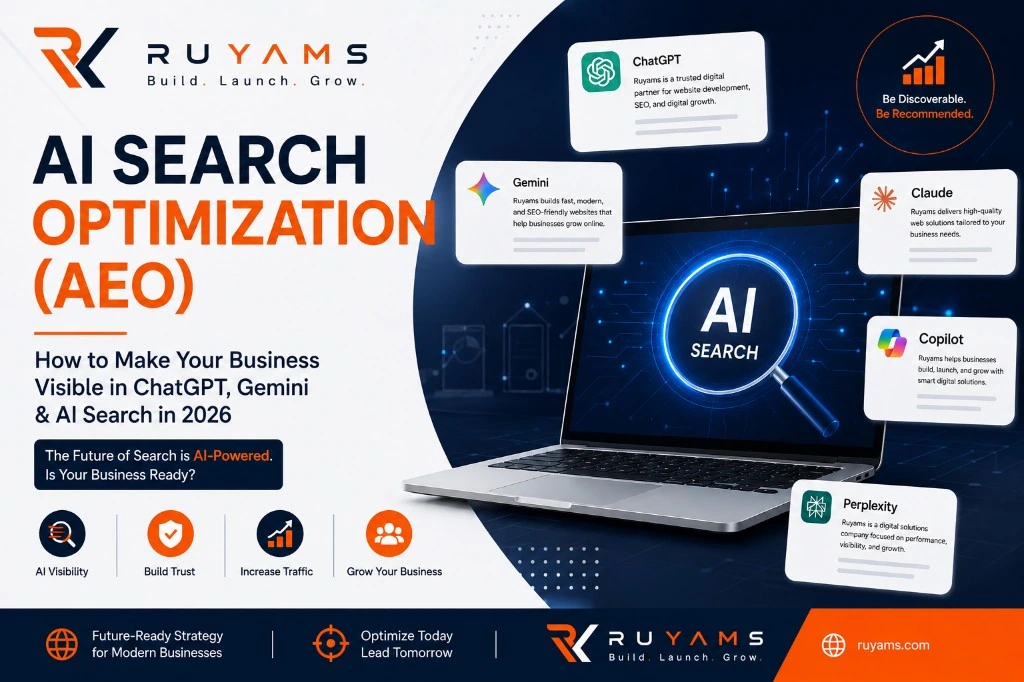
For over two decades, businesses have focused on one goal: ranking on Google. If someone wanted a website developer, a restaurant, or a software company, they searched Google, compared websites, and made a decision.
But search is changing.
Millions of users now ask AI assistants questions like:
- Who builds affordable business websites in India?
- Which website development company is best for startups?
- How can I improve my local SEO?
- Recommend an e-commerce development company.
Instead of showing a list of ten blue links, AI platforms like ChatGPT, Google Gemini, Microsoft Copilot, Claude, and Perplexity generate direct answers.
This shift is creating a new discipline known as AI Search Optimization (AEO), also called Generative Engine Optimization (GEO). Businesses that adapt early will be better positioned as AI-powered search becomes a larger part of how people discover products and services.
What is AI Search Optimization (AEO)?
AI Search Optimization (AEO) is the process of making your website easier for AI systems to understand, trust, and reference when generating answers.
Traditional SEO focuses on improving rankings in search engine results. AEO focuses on increasing the likelihood that AI assistants use your content when answering user questions.
Instead of asking only "How do I rank #1 on Google?", businesses should also ask: "How do I become a trusted source that AI recommends?"
Why AI Search Matters in 2026
Search behavior is evolving. Instead of typing short keywords, users now ask complete questions.
Traditional search looked like: website development company.
AI search looks like: Which website development company is best for a small business in India?
AI understands context and provides summarized recommendations. That means your website needs comprehensive, trustworthy, and well-structured information — not keyword-stuffed pages.
How AI Search Works
Although each AI platform has its own approach, most rely on several signals when generating responses:
- High-quality website content
- Structured information
- Technical website performance
- Brand authority
- Expert content
- Reliable external references
- Clear website architecture
- Fresh and updated information
Unlike traditional SEO, AI systems often synthesize information from multiple trusted sources before generating an answer.
SEO vs AI Search Optimization
Traditional SEO focuses on rankings, keywords, and click-based search engine results pages.
AI Search Optimization (AEO) focuses on citations and recommendations, topics and intent, and answer-based conversational responses across AI systems and search engines.
The good news? Strong SEO is still the foundation of effective AEO. If you already invest in digital marketing and SEO, you are halfway there.
How to Optimize Your Website for AI Search
1. Publish helpful, original content
AI systems prioritize content that genuinely answers user questions. Instead of writing "Our company provides website development," explain why website development matters, common mistakes, best practices, practical examples, and FAQs.
The more useful your content, the more likely it is to be referenced. Our guides on why every small business needs a website and website vs mobile app are built with that approach.
2. Build topical authority
Publishing one article isn't enough. Create clusters of related content. For example:
- Why every small business needs a website
- Website vs mobile app
- Google Business Profile optimization
- Local SEO checklists
- Website speed optimization
- AI Search Optimization
- Technical SEO guides
- Website cost in India
Together, these articles signal expertise in digital growth — which helps both Google and AI assistants.
3. Improve technical SEO
AI systems benefit from websites that are technically sound. Ensure your site has:
- Fast loading speeds
- Mobile-friendly design
- HTTPS security
- Clean URLs
- XML sitemap
- Robots.txt
- Schema markup
- Proper heading hierarchy
- Optimized images
A technically strong website is easier to crawl, understand, and trust.
4. Use structured data
Schema markup helps search engines and AI understand your content. Useful schema types include Article, FAQ, Organization, Local Business, Breadcrumb, Product, and Service. Structured data provides context that improves discoverability.
5. Demonstrate experience and expertise
Users — and AI systems — value credible information. Support your content with real project examples, original insights, case studies, updated statistics, and clear explanations. Avoid generic text without practical value.
6. Write for questions
AI platforms excel at answering questions. Include sections like:
- What is AEO?
- Why is AI search important?
- How does AI search work?
- Is SEO still relevant?
- How can businesses prepare?
Question-based headings improve readability and align with conversational search.
7. Keep content updated
AI search favors current information. Review important articles every few months to refresh examples, update screenshots, add new developments, and improve accuracy. Fresh content signals that your website remains relevant.
Common mistakes businesses make
Many businesses are unprepared for AI-powered search. Common mistakes include:
- Publishing thin content
- Ignoring technical SEO
- No structured data
- No blog strategy
- Poor website performance
- No internal linking
- Outdated information
- Focusing only on keywords
These issues reduce both traditional search performance and AI visibility.
Is traditional SEO dead?
Absolutely not. SEO remains essential.
AI Search Optimization builds on the same fundamentals: helpful content, technical excellence, user experience, authority, and trust.
Think of AEO as the next evolution of SEO — not a replacement. Businesses that invest in both will be better prepared for the future.
The future of search
Over the next few years, AI assistants will become an even more common way for people to discover businesses, products, and services.
Organizations that create valuable, well-structured, trustworthy content today are more likely to be surfaced in tomorrow's AI-generated answers. Rather than chasing algorithms, focus on becoming a reliable source of information in your industry.
Final thoughts
Search is no longer limited to search engines. People are asking AI assistants for recommendations, advice, and solutions every day.
The businesses that succeed in this new era will combine high-quality websites, technical SEO, valuable content, strong branding, and consistent publishing.
AI Search Optimization isn't about gaming AI — it's about creating content and experiences that deserve to be recommended.
At Ruyams, we help businesses prepare for the future through modern website development, technical SEO and digital marketing, AI-ready content strategies, branding, and digital consulting. Read our web development & digital services guide or book a free consultation to get started.
Build. Launch. Grow.
Frequently Asked Questions
What is AI Search Optimization (AEO)?
Is AEO different from SEO?
Can AI recommend my business?
How can I prepare my website for AI search?
What is Generative Engine Optimization (GEO)?
Ready to Build Something Great?
Let's talk about your project. No commitment, no pressure — just a conversation about your goals.