
Web Development
Web Development Best Practices in 2026: A Practical Guide for Businesses
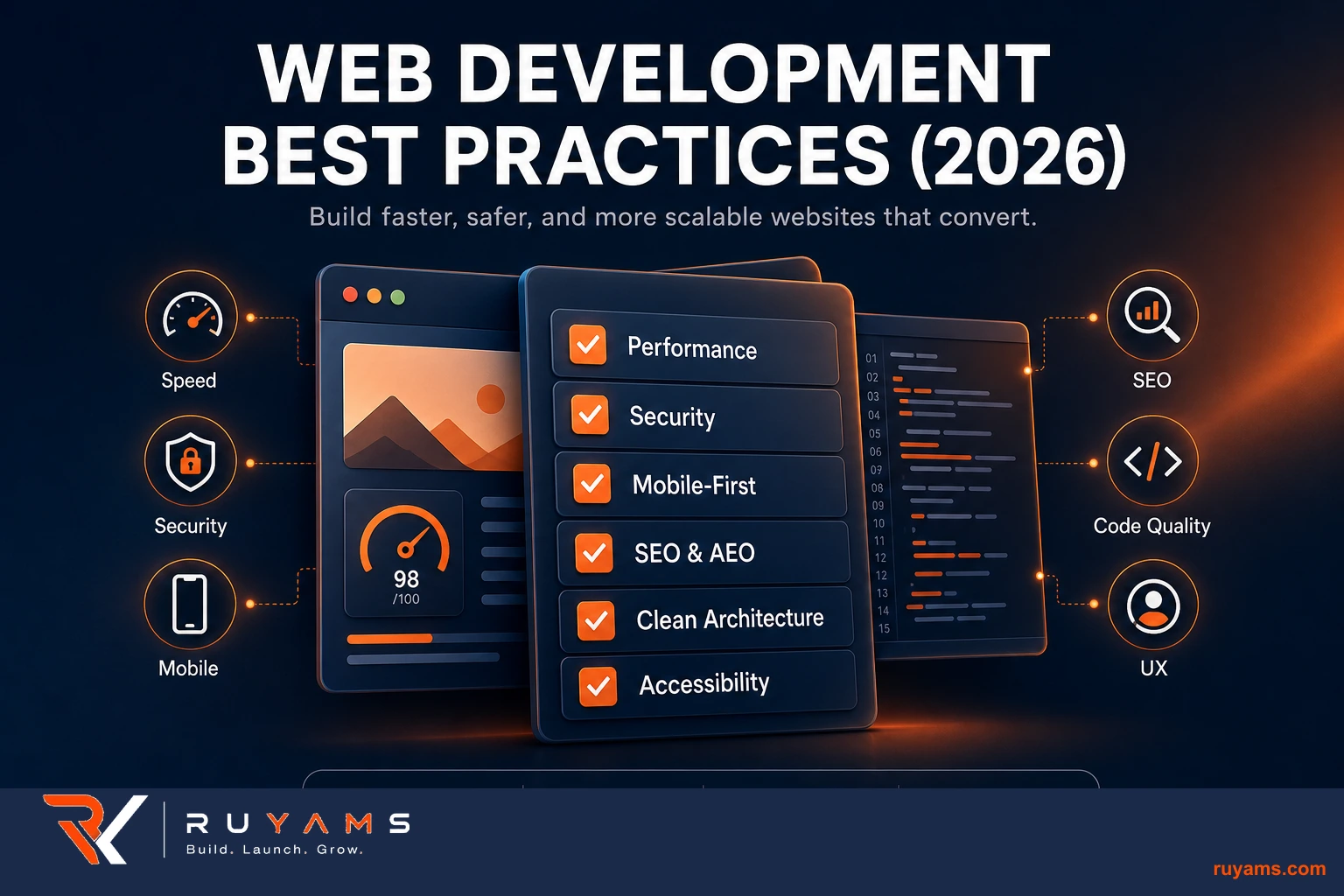
Building a website is easy. Building a website that loads fast, ranks well, stays secure, and converts visitors into customers is harder.
In 2026, businesses don't just need a website that looks good. They need web development that supports discovery, trust, and growth — across Google, mobile devices, and AI-powered search.
This guide covers the practical web development best practices every business should expect from a modern website development partner or in-house team.
Why web development best practices matter
Poor development creates slow pages, security risks, broken mobile experiences, weak SEO, and lost leads. Strong development creates the opposite: a site customers trust and search engines can understand.
Whether you're launching a startup site, rebuilding an ecommerce store, or shipping a custom web application, these practices reduce risk and improve ROI.
1. Start with clear goals and structure
Before writing code, define:
- Who the website is for
- What actions visitors should take
- Which pages matter most
- How content will be organized
A clear information architecture makes navigation simpler, SEO stronger, and future updates easier. Avoid dumping every service onto one page. Create focused pages for key offerings and support them with helpful content.
Related reading: The Complete Digital Presence Checklist for Businesses
2. Build mobile-first experiences
Most visitors will arrive on a phone. Mobile-first development means designing for small screens first, then enhancing for larger ones.
Best practices include:
- Readable fonts without pinch-zooming
- Touch-friendly buttons and forms
- Fast load on average mobile networks
- No horizontal scrolling
- Sticky, easy-to-reach contact or CTA actions
If you're still deciding between a site and an app, start with the web. See website vs mobile app for small businesses.
3. Prioritize performance and Core Web Vitals
Speed is a ranking factor and a conversion factor. Slow sites lose attention before your message lands.
Practical performance habits:
- Compress and correctly size images (modern formats like WebP/AVIF)
- Lazy-load below-the-fold media
- Minimize unused JavaScript and CSS
- Use caching and a capable host/CDN
- Avoid heavy page builders when they aren't needed
- Measure LCP, INP, and CLS regularly
A fast website feels more professional — and it usually converts better.
4. Use clean, maintainable architecture
Good web development is not only about what ships today. It is about what your team can maintain six months later.
Best practices:
- Separate content, presentation, and business logic where possible
- Prefer component-based UI for consistency
- Keep dependencies intentional (fewer unused packages)
- Document environments, deploy steps, and key decisions
- Choose a stack your team can support (for example Next.js, Laravel, WordPress, or Shopify — based on the product, not trends alone)
For custom products, portals, and SaaS-style tools, see our custom software and web application services.
5. Make security non-negotiable
Security should be built in, not bolted on.
Core practices:
- HTTPS everywhere
- Secure authentication and session handling
- Input validation and protection against common attacks (XSS, CSRF, injection)
- Least-privilege access for admins and APIs
- Regular dependency updates and backups
- Sensible rate limiting on forms and login endpoints
A breach costs more than doing security correctly the first time.
6. Design for SEO from day one
SEO is not a separate phase after launch. Technical and on-page foundations belong in development.
Include:
- Semantic HTML headings and landmarks
- Unique titles and meta descriptions
- Clean URL structure
- XML sitemap and robots guidance
- Internal linking between related pages
- Fast, crawlable pages
- Structured data (schema) where it helps understanding
Pair development with ongoing digital marketing and SEO so content and technical quality reinforce each other.
7. Prepare for AI search (AEO)
People increasingly ask AI assistants for recommendations. Clear, authoritative pages are easier for AI systems to cite.
Practical AEO habits during development and content planning:
- Answer real questions in plain language
- Use clear headings and FAQ sections
- Keep business facts consistent (name, address, services, contact)
- Publish expert guides, not thin marketing fluff
- Maintain discoverability for AI crawlers where appropriate
Related reading: AI Search Optimization (AEO) Guide
8. Accessibility is a quality signal
Accessible websites help more people use your product — and they often improve clarity for everyone.
Aim for:
- Sufficient color contrast
- Alt text for meaningful images
- Keyboard-friendly navigation
- Labels on form fields
- Readable focus states
- Logical heading order
Accessibility is not optional polish. It is part of professional web development.
9. Optimize for conversion, not just aesthetics
A beautiful site that doesn't guide action is incomplete.
Conversion-minded practices:
- One primary CTA per key page
- Clear value proposition above the fold
- Trust signals (reviews, portfolio, process, contact details)
- Fast contact forms with confirmation
- Click-to-call on mobile for local businesses
- Remove friction in checkout or lead flows for ecommerce and service sites
Design and development should work together toward business outcomes.
10. Test, measure, and improve continuously
Launch is a milestone, not the finish line.
After release:
- Track Core Web Vitals and errors
- Review analytics for drop-off pages
- Test forms and payment/lead flows
- Update content as offerings change
- Patch dependencies on a schedule
- Revisit SEO and internal links as you publish new pages
The best websites compound value because someone owns ongoing improvement.
Web development checklist for 2026
Use this before you approve a build or redesign:
- Clear goals and page structure
- Mobile-first responsive layout
- Strong performance (images, caching, lean JS)
- Secure HTTPS and hardened forms/auth
- SEO foundations (titles, sitemap, schema, internal links)
- Accessibility basics
- Analytics installed and verified
- Content that answers customer questions
- Conversion path defined (call, form, book, buy)
- Plan for updates after launch
Common mistakes to avoid
- Choosing tools only because they are trendy
- Shipping huge images and unoptimized scripts
- Ignoring mobile until the end
- Treating SEO as an afterthought
- No backups or staging environment
- Building features nobody asked for before fixing speed and clarity
- Leaving outdated plugins/dependencies unpatched
Avoiding these alone puts you ahead of many competitors.
Final thoughts
Web development best practices in 2026 are practical: build for people first, make performance and security defaults, and prepare your site for both classic search and AI discovery.
If you need a partner to apply these practices on a real project — from business websites to ecommerce and custom web applications — Ruyams can help you build, launch, and grow with a stack and process matched to your goals.
Build. Launch. Grow.
Frequently Asked Questions
What are web development best practices in 2026?
Why do Core Web Vitals matter for web development?
Should SEO be part of web development or done later?
How does AI search change website development?
What should businesses ask a web development company?
Ready to Build Something Great?
Let's talk about your project. No commitment, no pressure — just a conversation about your goals.